

RECENTLY READ
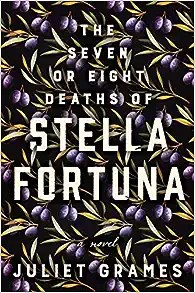
The Seven or Eight Deaths of Stella Fortuna by Juliet Grames
Ievoli, Italy, 1920 – Connecticut, Present Day: Stella Fortuna’s childhood is full of strange, life-threatening incidents—moments where ordinary situations like cooking eggplant or feeding the pigs inexplicably take lethal turns. In her rugged Italian village, Stella is considered an oddity—beautiful and smart, insolent and cold. Stella uses her peculiar toughness to protect her slower, plainer baby sister Tina from life’s harshest realities. When the Fortunas emigrate to America on the cusp of World War II, Stella and Tina must come of age side-by-side in a hostile new world with strict expectations for each of them.
This was becoming one of my top five favorite books until I got to the final third of the novel. Stella’s life pre-motherhood is one rich with angst and a yearning for independence. The ending storyline of the book feels like a death of her true self. As a reader, I grieved the changes in Stella’s character and wanted that final act of redemption to her youthful spirit. I believe Grames will have many more successes in her future. She’s quite a fantastic storyteller and narrator.

Anatomy: A Love Story by Dana Schwartz
Edinburgh, 1817: Hazel Sinnett is a lady who wants to be a surgeon more than she wants to marry. Jack Currer is a resurrection man who’s just trying to survive in a city where it’s too easy to die. When the two of them have a chance encounter outside the Edinburgh Anatomist’s Society, Hazel thinks nothing of it at first. But after she gets kicked out of renowned surgeon Dr. Beecham’s lectures for being the wrong gender, she realizes that her new acquaintance might be more helpful than she first thought.
An easy read for me almost always consists of: one part beautiful cover, one part history, one part breaking the glass ceiling, and one part good ole fashioned love story. Anatomy checked all four boxes while also covering the fascinating topic of medicine during the nineteenth-century. I’ve already put the sequel, Immortality: A Love Story on hold at the library.
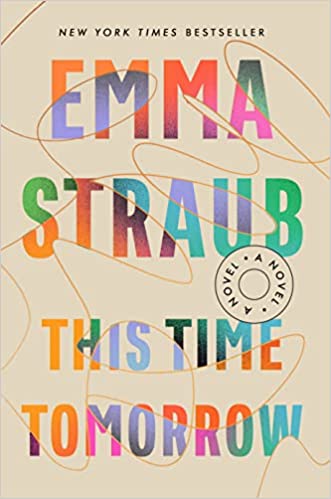
This Time Tomorrow by Emma Straub
Manhattan, Present Day + 1996: On the eve of her fortieth birthday, Alice’s life isn’t terrible. She likes her job, even if it isn’t exactly the one she expected. She’s happy with her apartment, her romantic status, and her independence, and she adores her lifelong best friend. But her father is ailing, and it feels to her as if something is missing. When she wakes up the next morning, she finds herself back in 1996, reliving her sixteenth birthday. Now armed with a new perspective on her own life and his, some past events take on new meaning. Is there anything that she would change if she could?
Another book club recommendation, this remarkable read came at the exact right time. Alice’s journey of understanding the love and grief for her father mirrors my own experience with my grandfather’s recent cancer diagnosis. One of the statements in the novel that showcases this sentiment reads, “Maybe that was the trick to life: to notice all the tiny moments in the day when everything else fell away and, for a split second, or maybe even a few seconds, you had no worries, only pleasure, only appreciation for what was right in front of you.” This is a book that will stick with me for years to come.

Surviving Savannah by Patti Callahan
Savannah, Georgia, 1838 + Present Day: When Savannah history professor Everly Winthrop is asked to guest-curate a new museum collection focusing on artifacts recovered from the steamship Pulaski, she’s shocked. The ship sank after a boiler explosion in 1838, and the wreckage was just discovered, 180 years later. Everly can’t resist the opportunity to try to solve some of the mysteries and myths surrounding the devastating night of its sinking.
I was in need of getting caught up in a good story. Nothing too serious, nothing too cerebral, nothing too life-changing. Surviving Savannah met that need and more. Having visited Savannah a few times, I really enjoyed the descriptive language surrounding the magic of the city’s landscape, the introduction to museum curation and shipwreck lore, and the alternating perspectives that kept the story moving along. I’m looking to reading more of Callahan’s work.

The Teacher of Warsaw by Mario Escobar
Poland, 1939: When over four hundred thousand Jewish people are rounded up and forced to live in the 1.3-square-mile walled compound of the Warsaw ghetto, sixty-year-old, Janusz Korczak and his friends take drastic measures to shield the children of his Jewish orphanage, Dom Sierot, from disease and starvation. With dignity and courage, the teachers and students create their own tiny army of love and bravely prepare to march toward the future—whatever it may hold.
Written with vivid autobiographical anecdotes, this book felt like peaking into someone’s daily life. It read like the best mix of non-fiction realism and the deep character development that fiction often provides. The image of Janusz and his final act of heroism is one that has left an imprint on my soul. It leaves me yearning to be more like someone who can face inescapable hardship with his courage and humility.

Beneath a Scarlet Sky by Mark Sullivan
Italy, 1943: Pino Lella wants nothing to do with the war or the Nazis. He’s a normal Italian teenager―obsessed with music, food, and girls―but his days of innocence are numbered. When his family home in Milan is destroyed by Allied bombs, Pino joins an underground railroad helping Jews escape over the Alps and is later forced to enlist as a German soldier where he is given a life changing opportunity. While a soldier, Pino becomes a spy for the Allies inside the German High Command and has to endure the horrors of the war and the Nazi occupation by fighting in secret.
Another Mark Sullivan masterpiece. The ability to transport the reader right into the story with geographical details, historical information, and characters rich with courage is one of Sullivan’s magic tricks. Beneath a Scarlet Sky is a story that makes the history of the human condition during World War 2 impossible to forget. Characters like Pino and his family are present-day beacons of hope for humanity during impossibly dark times. Sullivan spent nearly a decade researching and gathering information as he wrote this novels, and it shows.
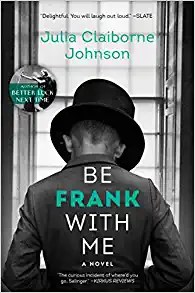
Be Frank with Me by Julia Clariborne Johnson
Los Angeles, Present Day: When Alice Whitley arrives at the legendary writer, M. M. “Mimi” Banning’s mansion, she’s put to work right away—as a full-time companion to Frank, Banning’s son, an eccentric nine-year-old boy with the wardrobe of a 1930s movie star and very little in common with his fellow fourth-graders. Alice becomes consumed with finding out who Frank’s father is, how his gorgeous “piano teacher and itinerant male role model” Xander fits into the Banning family equation—and whether Mimi will ever finish that book.
This was my bookclub’s pick for our spring reading. While totally out of the realm of what I’d normally choose to read, I did really enjoy the quirky and lovable nuances of Frank’s character. It was an easy to follow and light-hearted book, which couldn’t have come at a better time for me.
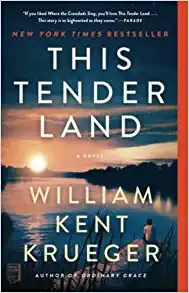
This Tender Land by William Kent Krueger
Minnesota, 1932: Odie O’Banion is an orphan confined to the Lincoln Indian Training School, a pitiless place where his lively nature earns him the superintendent’s wrath. Forced to flee after committing a terrible crime, he and his brother, Albert, their best friend, Mose, and a brokenhearted little girl named Emmy steal away in a canoe, heading for the mighty Mississippi and a place to call their own.
This book is a collection of rich history seamlessly woven together by Krueger. The Great Depression, spiritual tent revivals, Prohibition, and the reality of Native American lives during the early 1900s are explained through the perspectives of four young orphans, each endearing in their own way. Reading this felt like reading the best parts of Where the Crawdads Sing by Delia Owens, Four Winds by Kristen Hannah, and Huckleberry Finn by Mark Twain.
 sincerely swaim
Leave a comment